When Jesus Read Jesus to Them
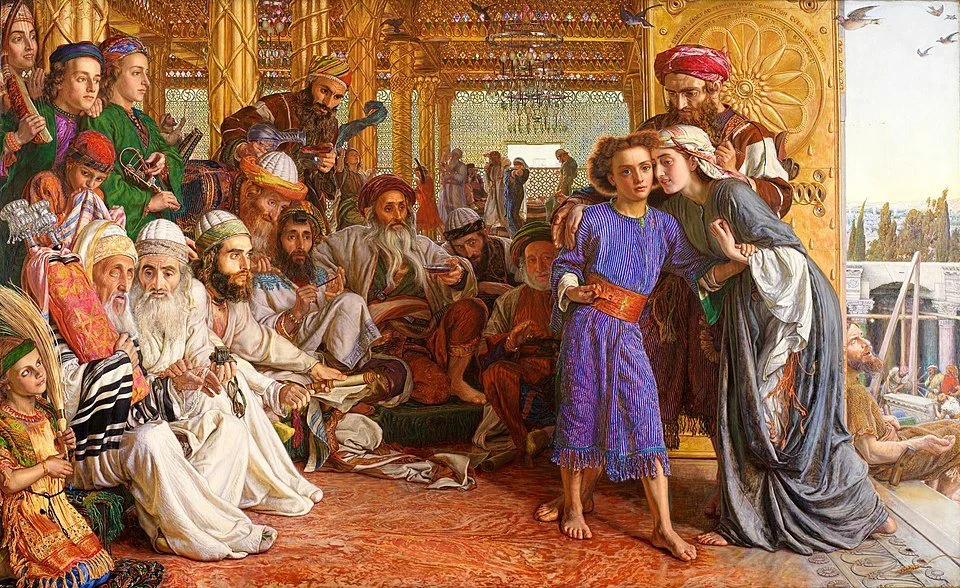
The Finding of the Saviour in the Temple
Luke 24:27 "And beginning with Moses and all the Prophets, he interpreted to them in all the Scriptures the things concerning himself."
Birmingham, England. The City Museum and Art Gallery holds one of the great Pre-Raphaelite religious paintings of the nineteenth century: William Holman Hunt's The Finding of the Saviour in the Temple. Hunt, a converted skeptic who took his Christianity with the seriousness of a man who had argued his way to it, sailed to Jerusalem in 1854 to begin the painting and worked on it for six years. He hired actual Jewish men of various traditions, Karaite, Sephardi, Ashkenazi, as his rabbi models. He studied the architecture, the textiles, the scrolls, the phylactery boxes. He inscribed Malachi 3:1 in Hebrew and Latin on the wall behind Joseph's head:
"The Lord whom you seek will suddenly come to His temple."
At the center of the canvas is the twelve-year-old Jesus, freshly recovered by His parents after three days, standing in the courtyard of the Temple. Around Him are the rabbis. Their faces in the painting are a study in possible responses to the Messiah: some intrigued, some annoyed, some openly hostile, the chief among them blind and clutching the Torah scroll to his chest as if to keep it safe from the boy who is the very subject of every page he is holding.
Hunt understood something most of us miss. The Old Testament Jesus had been reading from boyhood was not a different book from the one He would later open on the Emmaus road. It was the same book, with the same subject, who that day was sitting in the Temple courtyard listening to the men who were supposed to be teaching it.
Read Luke 24:27 again. The risen Jesus, on the road to Emmaus, is walking with two heartbroken disciples who have just watched their hopes die on Friday. He doesn’t show them His scars or part the clouds or summon angels. He opens His Bible. "Beginning with Moses and all the Prophets, he interpreted to them in all the Scriptures the things concerning himself." The risen Lord's first sermon was a sermon on the Old Testament.
This should rearrange how we hold the first thirty-nine books of our Bibles.
Many of us treat the Old Testament like a long, sometimes confusing, sometimes troubling prologue. The real story begins in Matthew, we assume. Genesis through Malachi is background information. Useful for context. Occasionally beautiful. Mostly the warm-up act before Jesus walks onto the stage. We read the Psalms. We dabble in Proverbs. We tiptoe past Leviticus. And we mistake our awkwardness for the Old Testament's irrelevance.
Jesus had a different view. He told the religious leaders of His day, "You search the Scriptures because you think that in them you have eternal life; and it is they that bear witness about me" (John 5:39). He told them Moses wrote about Him (John 5:46). He told the disciples in the upper room that everything written about Him in the Law of Moses, the Prophets, and the Psalms had to be fulfilled (Luke 24:44). The risen Christ wasn’t improvising. He was reading His own face out of pages He had inspired centuries before His own birth.
And here’s what the painter Hunt understood that many of us forget. The Old Testament isn’t the Christian's borrowed appendix. It’s the lifelong love letter of a God who chose Abraham's family as the cradle for the Savior of the whole world. Paul tells the Gentile believers in Rome they are wild branches grafted into a Jewish root, never the other way around (Rom 11:17-18). The Hebrew Scriptures are the soil out of which our Christ grew.
This week, our church sat under the preaching of David Brickner of Jews for Jesus, a brother whose own people preserved these Scriptures for two thousand years before any of us showed up to read them. He helped us see Jesus in books many of us have never read with the right eyes. So this week is a posture of learning. We aren’t going to bring the New Testament back to the Old Testament and impose Him on it. We’re going to ask the Old Testament to show us the One who has been there the whole time.
Today: Name one Old Testament book or passage you’ve never been able to see Jesus in. Job. Numbers. Lamentations. The kings. Pick one. Write it down. Pray simply: Lord, show me Your Son in this.
Prayer: “Father, I worship You for a Christ who is the subject of every page of Your Word. Forgive me for treating the Old Testament as a dim hallway to the New; the same Christ has been speaking from the start. This week, open my eyes to see Your Son where I haven’t yet looked for Him. In Jesus' name, Amen.”
-PK