Trust the Instruments
1 Corinthians 4:3-4 - “But with me it is a very small thing that I should be judged by you or by any human court. In fact, I do not even judge myself. For I am not aware of anything against myself, but I am not thereby acquitted. It is the Lord who judges me.”
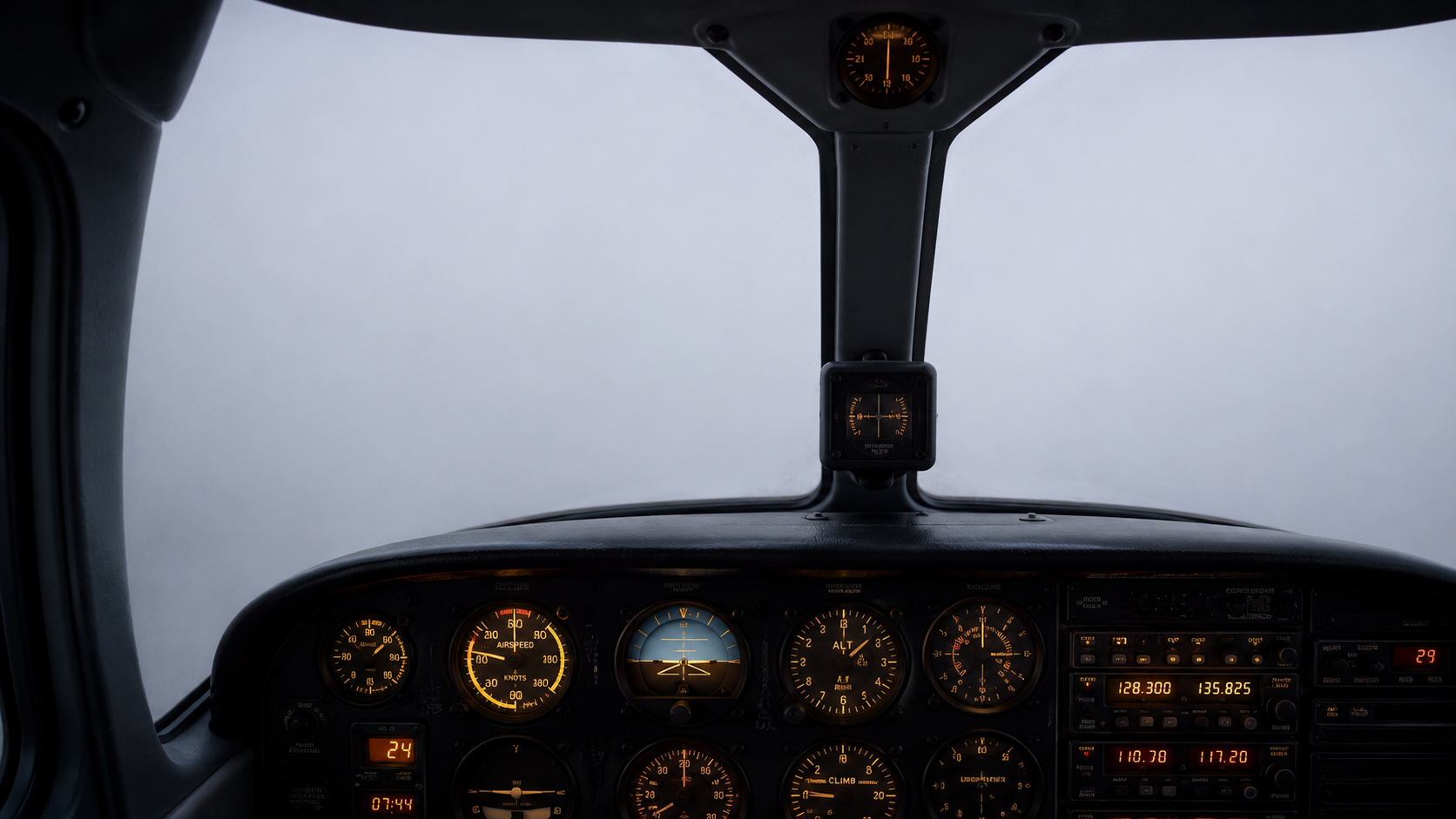
Pilots are trained for a moment that can kill them, a moment when their own body lies to them with total confidence. Fly into a cloud, lose sight of the horizon, and the inner ear can begin telling a story that isn’t true. The aircraft may enter a gradual turn so smoothly that the body stops registering the motion. The pilot can feel, with complete certainty, that the plane is straight and level, even when the instruments say otherwise. This is the world of spatial disorientation. And the only thing that saves a pilot in that moment is a discipline that feels deeply unnatural: stop trusting what your body is screaming, and trust the instruments. The artificial horizon is telling the truth, and the pilot has to believe it over the loud, lying certainty in his own gut.
Paul is doing something just as counterintuitive in verses 3 and 4, and it cuts against everything our culture believes about being true to yourself. “But with me it is a very small thing that I should be judged by you or by any human court. In fact, I do not even judge myself.” We can probably follow him halfway. We’re comfortable with the idea that we shouldn’t live for the crowd’s opinion. We say it constantly. Don’t let them define you. Don’t live for their applause. But watch how far Paul actually goes. He refuses the crowd’s verdict, yes, and then he keeps walking right past it and refuses his own.
Look at his humble reasoning in verse 4: “For I am not aware of anything against myself, but I am not thereby acquitted.” In plain terms: my conscience is clear, and even that doesn’t prove I’m innocent. This is the spiritual version of spatial disorientation. Your conscience is an instrument, and, like the inner ear, it can be wrong with total confidence. It can be numbed by repetition, miscalibrated by years of quiet self-justification, rolling you slowly into a spiral while assuring you that you’re flying straight. A clear conscience isn’t the same thing as a clean record. We can feel completely fine about ourselves and be completely off course, because the part of us doing the feeling is the very part with the most to gain from telling us we’re okay.
Now you might expect that to be terrifying. If we can’t trust the crowd and can’t even trust ourselves, then who’s left to tell us the truth about us? Paul’s answer is the most restful line in the passage: “It is the Lord who judges me.” There is Someone whose instruments never lie, who sees every hidden corner the crowd can’t see and every blind spot we can’t see in ourselves, and who reads the purposes of the heart with perfect accuracy and perfect love. And for the believer, that is pure relief. It means we can finally climb down off the exhausting throne of being our own judge. We don’t have to keep manufacturing a verdict of “good enough,” defending it against every critic, propping it up when it wobbles at three in the morning. We can hand the whole question to the only One qualified to answer it. And rest.
And the only reason this is restful instead of frightening is the gospel. The Judge whose verdict we await is the same Lord who already went to the cross to secure us. We’re entrusting ourselves to a Father who has, in Christ, already settled the deepest question of all, not surrendering to a hostile examiner hunting for a reason to condemn. Tomorrow we’ll see what He does with that verdict. For today, it’s enough to stop trusting the lying gauges, the crowd’s and our own, and to say with Paul, in relief rather than dread, “It is the Lord who judges me.”
Today: Take a few minutes of silence and notice the verdicts you keep handing yourself, the harsh ones and the flattering ones alike. Then, instead of arguing with them or believing them, simply release them to the Lord who judges with perfect accuracy and perfect love.
Prayer: “Father, thank You that the final word about me doesn’t come from the crowd or my own unreliable heart. I praise You as the One whose sight is perfect, who reads every hidden corner with both accuracy and love. Thank You that in Christ I can place the whole question of my standing into Your hands and rest. I love You, the only Judge whose verdict is at once completely true and completely safe. Amen.”
-PK