The Book That Outlived a Thousand Years in a Jar
Isaiah 40:8 "The grass withers, the flower fades, but the word of our God will stand forever."
In the winter of 1946, somewhere in the Judean wilderness above the Dead Sea, a young Bedouin shepherd named Muhammed edh-Dhib was looking for a lost goat. He climbed the cliffs, checked the caves, and at one point threw a rock into a dark opening to flush his animal out. But he didn’t hear a goat. He heard the sound of pottery breaking.
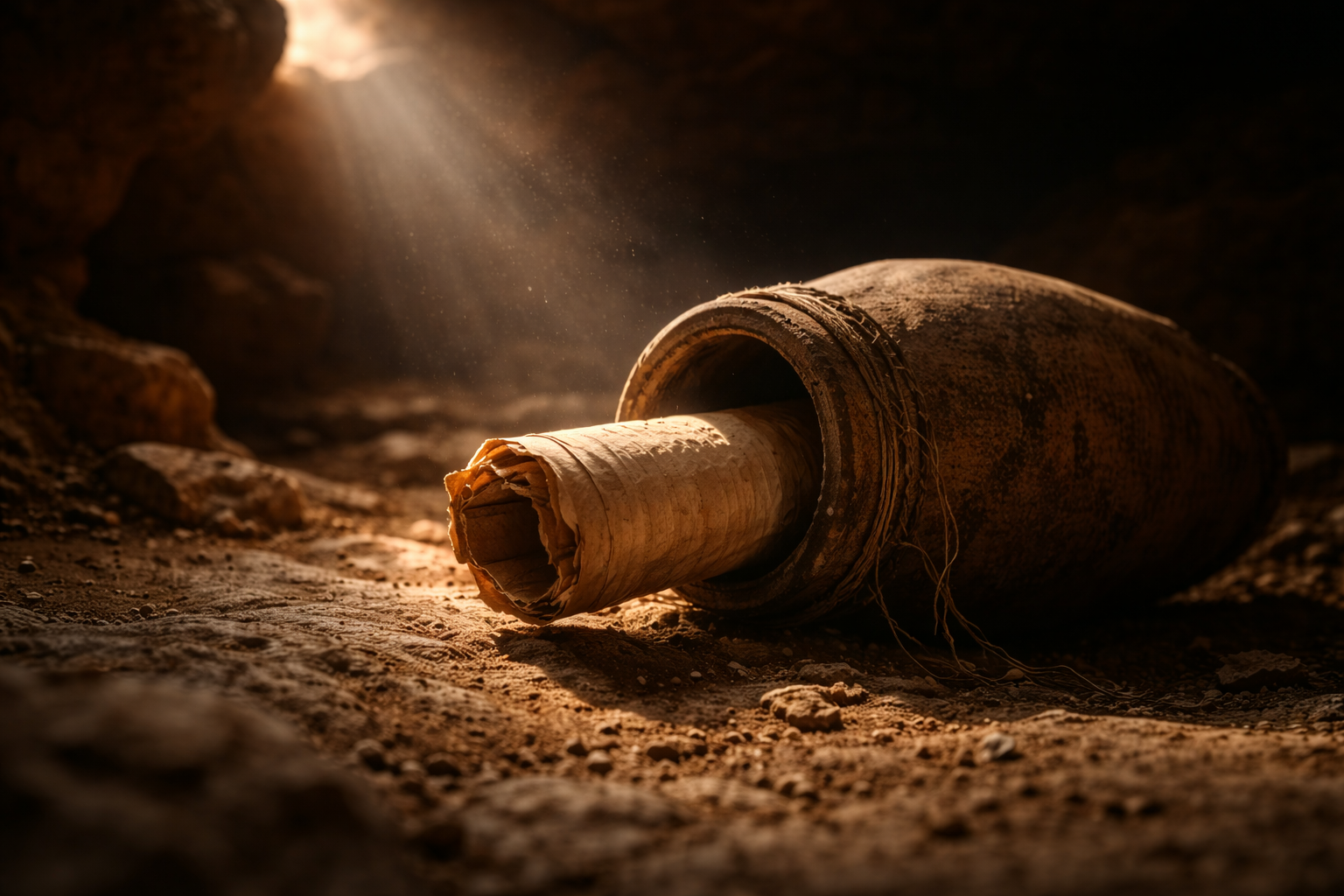
Inside that cave he found tall clay jars. Most were empty. Two were not. Inside them, wrapped in linen that hadn’t been touched in almost 2,000 years, were ancient scrolls. He couldn’t read them, so he brought them home. They passed from shepherd to antiquities dealer to the Syrian Orthodox Metropolitan in Jerusalem to the eyes of the world. Before the decade was over, ten more caves would be opened in the same cliffs. Nine hundred manuscripts would be recovered, including fragments of almost every book of the Hebrew Bible.
The jewel of the collection was the Great Isaiah Scroll. Twenty-four feet of parchment, fifty-four columns, the entire book of Isaiah in Hebrew, handwritten around 125 BC. Until Muhammed edh-Dhib's rock hit that jar, the oldest complete Hebrew Isaiah we possessed was from the year AD 1008. A thousand years newer. Scholars held their breath. If the text had drifted across those ten centuries of copying, the cracks would show here.
It hadn’t drifted.
The Great Isaiah Scroll, compared against the standard Masoretic text a thousand years its junior, is remarkably close. The differences that exist are mostly spellings, scribal marks, small variations in wording. None of them touches a single doctrine. A Jewish scribe in 125 BC and a Jewish scribe in AD 1008 copied the same Isaiah, and a shepherd stumbled onto the proof in 1947. The Isaiah you hold in your Bible this morning is, in all the ways that matter, the Isaiah the apostles held, the Isaiah Jesus unrolled in the Nazareth synagogue (Luke 4:16-21), the Isaiah Philip read to the Ethiopian eunuch on the wilderness road (Acts 8:32).
Our Statement of Faith at Bayside confesses that Scripture is inerrant in the original writings. The honest question many of us carry is this: how can we be confident that what we hold in English today still reflects what God breathed out through prophets and apostles so long ago? The Dead Sea Scrolls are one of God's answers. And they aren’t the only one. We have over 5,800 Greek manuscripts of the New Testament, some of them fragments dated within a generation of the apostles themselves. No document from the ancient world comes close. The Bible you open at your kitchen table is the most textually attested book in the history of human literature.
But preservation isn’t an argument to brandish; it’s a gift to receive with trembling.
The same God who leaned in and breathed out Scripture (2 Tim 3:16) also watched over every quill, every fire, every exile, every empire that tried to silence it. When Roman officials confiscated Bibles during the Diocletian persecution, He was preserving the Book. When medieval monks copied it by candlelight, He was preserving the Book. When William Tyndale was burned at the stake for translating it into English, He was preserving the Book. When a shepherd threw a rock into a cave chasing a goat, God was handing His church a thousand-year-old jar of proof that the grass withers, the flower fades, but the word of our God will stand forever.
Peter himself quoted that same Isaiah verse in his first letter (1 Pet 1:24-25). He couldn’t have known that two millennia later, we would still be reading it. But the God who moved Isaiah, and then Peter, and then a shepherd's goat, knew.
Today: Open your Bible to Isaiah 40. Read verses 6 through 8 aloud, slowly. Let the weight of what you are holding settle. This is the same Word that was folded into linen in a jar before Jesus was born, was read in first-century synagogues, was copied by hand in monasteries, was smuggled in coats through iron curtains, and is still speaking in your living room this morning. We didn’t keep this Book alive. He did. And He will.
Prayer: "Father, I worship You for the wonder of a Word kept for us across thousands of years. Thank You for preserving Your Word. Keep my heart tender toward every page today. In Jesus' name, Amen."
-PK