Romans 3:23–26 — For all have sinned and fall short of the glory of God, and are justified by his grace as a gift, through the redemption that is in Christ Jesus, whom God put forward as a propitiation by his blood, to be received by faith. This was to show God’s righteousness, because in his divine forbearance he had passed over former sins. It was to show his righteousness at the present time, so that he might be just and the justifier of the one who has faith in Jesus.
Today, doorbells will ring, candy bowls will empty, and parents will negotiate with their kids how much chocolate counts as enough. But October 31 carries a history that reaches beyond costumes. The name Halloween developed from All Hallows’ Eve, the evening before All Saints’ Day. A “hallow” is a saint. Centuries before our neighborhood traditions, this evening stood beside a Christian observance remembering the saints.
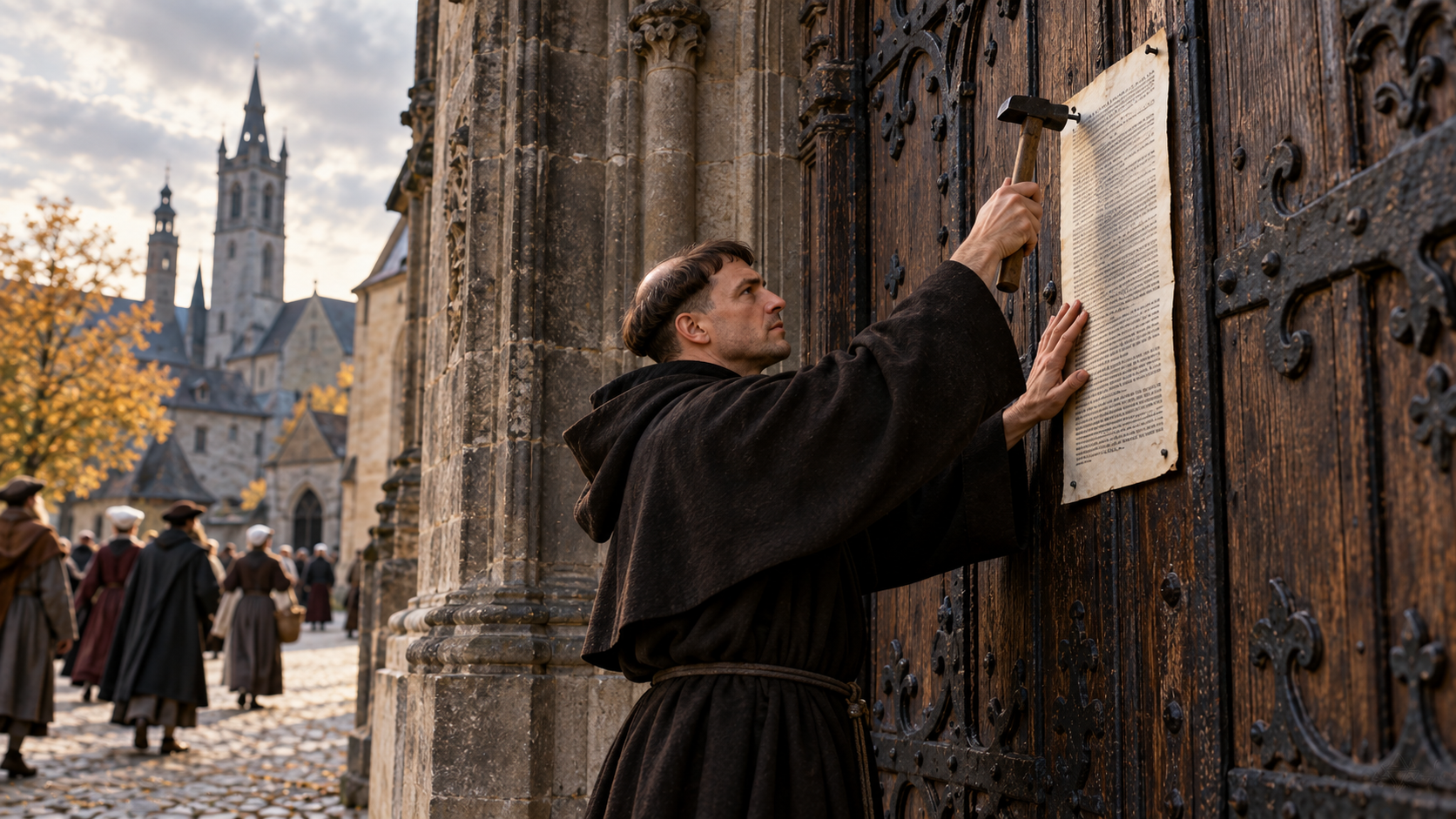
On October 31, 1517, Martin Luther sent ninety-five propositions for debate to Archbishop Albrecht. Luther was a Catholic monk, priest, and professor concerned about the promotion of indulgences. He was seeking reform within the church he served. The church taught that even forgiven sins could carry a remaining penalty, including purification after death in what it called purgatory. An indulgence reduced that penalty. Officially, it didn’t purchase forgiveness. But its promotion in connection with financial contributions encouraged people to believe that money could secure spiritual relief for themselves or loved ones who had died.
Imagine hearing that your mother was suffering after death and that your contribution could help release her. How much would be enough? How could you rest while wondering whether you should have given more? Luther challenged the abuses surrounding those promises. His protest helped set in motion the Reformation, during which a deeper question came to the foreground: How can a guilty person stand accepted before a holy God? The Reformers’ answer drew from passages like the one before us today: by God’s grace alone, through faith alone, because of Christ alone.
Listen to how Paul begins. “All have sinned and fall short of the glory of God.” With the statement, every mouth is silenced. The religious and the irreligious, the respected and the disgraced, the person with a lifetime of service and the person with a lifetime of regret — all need a righteousness they can’t produce. Then comes the astonishing announcement: we are justified “by his grace as a gift.” To be justified is to be declared righteous before God. This is the verdict of the Judge who knows everything about us. He knows the sins we confess and the ones we struggle to admit. Nothing has escaped His attention. Yet through faith in Jesus, we receive a standing before Him that our best efforts could never earn.
How can God give such a verdict and remain just? Paul’s answer is the blood of Christ. Jesus accomplished our redemption, securing our freedom at the cost of His own sinless life. Paul also calls His sacrifice a propitiation: Christ satisfied God’s righteous wrath against sin. Our forgiveness rests on God dealing fully with the sin nature we’ve inherited and the evil we’ve done. At the cross, God’s justice and mercy shine together. The Father lovingly gives His Son, and the Son willingly gives Himself. The judgment is borne and the redemption is accomplished. God remains perfectly righteous as He declares righteous the person who trusts in Jesus. The holy God we’ve sinned against has Himself provided everything necessary to bring us home.
This is the glory at the heart of the Reformation. Forgiveness could never be secured by coins dropped into a chest. Neither can it be secured by enough service, enough sorrow, or enough years spent trying to become worthy. Our confidence rests in a Savior who gave Himself for us and rose from the grave. Faith receives Him with empty hands. We don’t arrive with an impressive record of faithfulness or a promise that we’ll never struggle again. Christ is sufficient for the person who has nothing to plead except His mercy.
We can thank God for the recovery and proclamation of this truth through the Reformation. The reformers were imperfect people, and our gratitude ultimately rises beyond them to the Lord whose gospel they proclaimed. So today, whenever you say “Happy Halloween,” let that old word hallow remind you of something wonderful: through Jesus, you belong among God’s saints — His holy people, set apart by grace. The Savior who washes away your guilt also brings you into His family. You belong to Him. By grace. Through faith. Because of Jesus.
To God alone be the glory.
Head: My acceptance before God rests entirely on the sufficiency of Jesus.
Heart: What happens to my fear and striving when I remember that God gives the righteousness He requires?
Hands: Read Romans 3:23–26 slowly, then turn its truths into praise. Thank God specifically for His grace, Christ’s sacrifice, and the gift of being accepted through faith.
Prayer: “Heavenly Father, hallowed be Your name! Thank You for providing in Jesus the righteousness I could never produce and the redemption I could never purchase. Let my life become a grateful song of praise to the Savior whose work is sufficient and whose mercy is freely given. In Jesus’ name, Amen.”
-PK